Irish author and celebrity chef Darina Allen is a woman after my own heart… and not just because she has, shall we say, a fairly flexible approach to meeting deadlines. (In her credits for her latest book, Forgotten Skills of Cooking, she admits: “I once heard my publisher introducing me as, ‘my author who doesn’t start to write the book in earnest until the deadline has passed’. “)
Darina is the founder of the famous Ballymaloe Cookery School in Ireland and has spent her life promoting her passion for honest, seasonal, organic food. I interviewed her earlier this year, when she was holidaying in New Zealand, and she was charming. Charming and so full of enthusiasm for all those old culinary skills like smoking, bottling, brewing and butchering the odd animal. (I wrote about this book in my Down Country column in the Sunday magazine last month. Click here to read it.)
With more than 700 recipes, Forgotten Skills of Cooking is worth every cent of its $79.95 cover price (it’s published by Kyle Cathie and distributed in New Zealand by New Holland) I think it’s even better than Nigel Slater’s Tender Volume I (Vegetables) and Tender Vol. II (Fruit). And I think Nigel Slater is the thinking gardener’s crumpet (so to speak), so that’s saying something.
From small acorns, mighty oaks can grow…
If you’ve wondering why I’ve been a little quiet on the blogging front this month, I’ve been ever so slightly preoccupied with the arrival of our little fella. Lucas Sebastian Hinton arrived at 10.11am on June 7, weighing in at a sturdy 9lb 14oz (or 4.47kg). We think he’s pretty adorable. Almost as adorable, in fact, as all the lovely handknitted clothes he has been sent by friends, family members and NZ Gardener readers. Thanks to Jan Freeman for this gorgeous green outfit. How ever did you guess that it’s my favourite colour?
Okay, so its actually the 1st of June, but I took this photo yesterday, just as the weather pundits confirmed what we gardeners have been aware of for weeks: the weather was amazingly mild in May. In fact, it was the warmest May on record. NIWA climate scientists say it was almost 2.5 degrees warmer on average than usual, with twice as much rain too. Which explains why, among other things, my crabapples are in blossom, my asparagus is sending up out-of-season spears… and all my baby daffs have burst into bloom. Strange times.
Or should that be corn-u-copious? Who would have thought you could harvest buckets of fresh, sweet, succulent corn in the middle of a rather wintry May?
Back in January, I sowed 1200 sweetcorn seeds to fill up the gaps at the back of our wedding garden. I sowed it purely for decoration – I wanted a lush green backdrop and sweetcorn seemed the quickest, cheapest, most tropical-looking solution. I didn’t expect to get a crop; indeed the agricultural seed merchants I bought the bulk seed from initially wouldn’t sell it to me, because it was far too late in the season to be sowing it.
And they were right. The cobs that formed on the plants around our lawn were small and scungy. They were too far back in the border to get any benefit from the irrigation system, and then black aphids and green vege bugs (also known as shield beetles) descended like a plague and sucked the kernels dry.
But what a different story it has been on the steep hill below our house. This part of the garden used to be the chook run but, before the wedding, we carved it into four terraces with gravel paths to provide access for guests to get from their cars to the ceremony. My original plan was to sow wildflowers in the terraced beds, but then I ran out of time so I just chucked in heaps of corn just to keep the weeds at bay.
And now… we have ears of corn coming out of our ears. I should be composting the shabby old stalks after picking the cobs, but it’s far easier just to pull them out and biff them over the fence to the cows. They absolutely love the stuff. Ditto the chooks. They’re getting all the undersized cobs.
PS. NZ Gardener is now on Facebook. For tips and tricks or just to chat to us, click here.
Pros: Sweet, seedless, easy-peel ‘Satsuma’ mandarins are in season! I can buy them on my way home from a roadside stall near here for just $3/kg. They are divine. I could eat a whole bag in one go. Mum’s tree is also laden – she filled up my fruit bowl with even more mandarins this weekend.
Cons: Fresh citrus gives me chronic heartburn at the moment. I only have to look at a mandarin and my chest hurts. I’m chewing through antacid tablets almost as quickly as I’m chewing through the citrus. Ah well, not too many days to go now!
(But I have to admit, I a’m getting a bit tetchy about the state of my garden. Not being able to bend over is a definite disadvantage, but luckily Mum came to the rescue yesterday and put in a few punnets of cauliflowers, spinach, red-stemmed silverbeet and spring onions for me. This afternoon I also sowed a packet of ‘Dwarf Early Green’ broad beans, a packet of ‘Wiltshire Ripple’ sweet peas and prepared two dozen elderberry cuttings for the edible hedgerow I’m planning in our orchard. Now I just have to bribe my husband to mow the orchard so we can plant the 200 or so spring bulbs I’ve bought to go under the apple trees…)
I went to a cafe recently where they tried to charge me $8 for a glass of ho-hum ginger beer. That’s, well, ridiculous. You can bottle the stuff by the litre at home for next to nothing. All you need to get started is a spoonful of yeast (even if you use Premium Ginger Beer Yeast from a home brew store, it’s only going to set you back $2.70), a 30g box of ground ginger ($2.24 from the supermarket), a 1kg bag of sugar ($2.84) and a couple of lemons. That’s only $7.78 – and that’s enough to make 5 litres (or 20 glasses). And it goes without saying that homemade ginger beer tastes at least 20 times better than the bought stuff too.
To make your own ginger beer, you need to make a ginger beer bug first. I’m not sure why it’s called a bug – Mum says she used to call it a plant – but really it’s just a jar of bubbling gingery goo. Start with 1-2 tablespoons of dried yeast (if you don’t use brewer’s yeast, use Edmonds Active Yeast – it has a yellow lid, whereas the bread yeast has a red one). Place the yeast in a glass jar with 1 teaspoon sugar, 1 teaspoon ginger and 1 cup cold water. Cover the jar with a loose piece of fabric to stop bugs getting in but still allow the yeast to breathe, then place it somewhere warm for a day to get it going.
After that, feed the bug every day with 1 teaspoon sugar and 1 teaspoon ginger. Seven days later, you’re ready to bottle your first batch of fizz. In a large bowl, dissolve 2 cups sugar in 1 litre boiling water. Add the juice of 2-3 lemons and 4 litres of cold water. Then strain off the liquid off the top of the bug (set aside the sludge) and add to the water. Stir well and bottle.
I’ve been recycling plastic 1 litre water bottles (just because we had a stash of them left over from the wedding), but any soft drink bottles will do the trick. Keep an eye on them; as soon as they go hard or start to push out their bottoms, you know they’re full of fizz. Mine is generally ready to drink in 3-4 days. Chill the bottles before you open them; it calms the bubbles down.
The best thing about making ginger beer is that, once you’ve made the bug, all you have to do is keep feeding it. Once you’ve strained off the liquid, add a fresh cup of water to the sludge and start the whole process all over again (except you don’t need to add any yeast this time).
But what really spurred me to write about ginger beer today is that on Nine to Noon on National Radio this week, I heard chef Paul Jobin share his recipe for corned beef cooked in ginger beer. It sounds seriously good and, fortuitously, not only do I have plenty of ginger beer, I’ve also got several lumps of silverside in our freezer from the crazy old bull we culled last year!
To make Paul’s ginger corned beef, you need 1 corned silverside; 1 onion, peeled and sliced; 1 knob ginger, sliced; 1 orange, sliced; 1 lemon, sliced; 1 bay leaf; 4 sprigs thyme; 1 chilli, sliced; 2 bottles of ginger beer; and extra water. In a saucepan or crockpot, add all ingredients, adding water to cover the corn beef. Bring to the boil and simmer for 1½ hours (or overnight in the slow cooker) or until a skewer inserts easily. Allow to cool down in the stock.
I do love a good wedding, but I have to say I was a tad disappointed by Kate Middleton’s bridal bouquet. It was just so, well, tiny. It looked more like a flower girl’s posy. (A very pretty flower girl’s posy, nonetheless, but just a bit dinky compared to all the rest of the pomp and pageantry surrounding the occasion.)
Mind you, for such a small bouquet, it was oozing in symbolism. According to the official Royal Wedding website: “The bouquet is a shield-shaped wired bouquet of myrtle, lily-of-the-valley, sweet William and hyacinth. The bouquet was designed by Shane Connolly and draws on the traditions of flowers of significance for the Royal Family, the Middleton family and on the Language of Flowers. The flowers’ meanings in the bouquet are:
Lily-of-the-valley – Return of happiness Sweet William – Gallantry Hyacinth – Constancy of love Ivy: Fidelity; marriage; wedded love; friendship; affection Myrtle: the emblem of marriage; love.
The bouquet contains stems from a myrtle planted at Osborne House, Isle of Wight, by QueenVictoriain 1845, and a sprig from a plant grown from the myrtle used in The Queen’s wedding bouquet of 1947. The tradition of carrying myrtle begun after QueenVictoriawas given a nosegay containing myrtle byPrince Albert’s grandmother during a visit toGothainGermany. In the same year, QueenVictoriaandPrince Albertbought Osborne House as a family retreat, and a sprig from the posy was planted against the terrace walls, where it continues to thrive today. The myrtle was first carried by QueenVictoria’s eldest daughter, Princess Victoria, when she married in 1858, and was used to signify the traditional innocence of a bride.”
I love fragrant lily-of-the-valley (Convallaria majalis). It’s one of the classic perennials of spring, but it really needs a frosty winter climate to do well. I never managed to get these bulb-like plants to flower in my Aucklandcity garden, but we get wicked frosts here in Hunua, so I might just have another crack at establishing a clump under some trees this year. You can get the dormant rhizomes in selected garden centres now, or wait until spring for plants (look in the perennial section at your local garden centre), or check Trade Me for plants sold by hobby growers. Parva Plants also have an adorable pale pink-flowered form (Convallaria majalis var. rosea) but – drats – it has sold out for the season.
In my Down Country column in last weekend’s Sunday magazine in the Sunday Star Times, I wrote about making a batch of Jersey black butter, or nièr beurre. This spicy, treacle-coloured preserve dates back to the 1500s, when it was invented as a byproduct of the Channel Islands cider industry.
Here are the instructions from my column:
The traditional method is to simmer it for 30 hours, stirring constantly, in huge copper cauldrons over an open fire. You know it’s done when a wooden spoon, pressed into a sticky dollop on a plate, adheres sufficiently to lift the plate.
I don’t own a copper cauldron, and I doubt the council issues fire permits for preserving, so I made a scaled-down version in my slow cooker. Simmer 4kg peeled, sliced, cooking apples in 500ml fresh apple juice or dry, homemade cider for a few hours, till the apples turn to mush. Then add ½ cup caster sugar, a 40g log of natural liquorice, the zest and juice of 1 lemon, 1 teaspoon ground cinnamon and 1 teaspoon mixed spice. Ignore for the rest of the day, apart from the occasional stir.
It took 12 hours for my nièr beurre to turn into thick brown sludge (anyone care to translate that into Jersey’s Norman-French dialect?). But trust me, it tastes far nicer than it looks. I’ve been spooning it over porridge, slathering it on hot cross buns and folding it into custard fools. It’s delicious stirred through thick Greek yoghurt, or, even better, local Clevedon Valley Buffalo yoghurt, the 2010 supreme winner in Cuisinemagazine’s Artisan Awards.
I was boiling up a batch of wild hawthorn berry jelly this morning when I looked out the kitchen window and saw… seven tiny fluffy ducklings running around the driveway! Way to go Mama Duck! (Forgive the sudden outbreak of exclamation marks but I’m excited!)
Our female Pekin duck (I call her Streaky-Beak because she has a few stripes on her snozz) has been sitting on a nest of eggs under the barberry hedge on our far boundary for at least a month. It’s her second crack at motherhood (our puppy defeated her first attempt last spring when he found her nest under the conifer shelter belt and ate all 14 eggs in one go). But given how cold it has been getting at night here now, I didn’t hold out much hope that she’d be able to keep the eggs warm enough to hatch. In fact, just yesterday I was thinking I really should get her off the nest before she loses all her condition before winter.
Baby ducklings are so adorable. Unfortunately, they’re also appetising to hawks. We rounded up the ducklings before breakfast, then turfed the chooks out of the chook run and locked the quackers in there as a temporary measure. Ten minutes later, I saw the first hawk swoop. My maternal instinct kicked in (I went a little bananas) and I rushed out in my slippers to scare it off. So now the ducks are safely ensconced in the haybarn instead and Dad’s on his way over to give us a hand to rig up a temporary mesh run out the barn door.
Meanwhile, my haw jelly stuck to the pot. But who cares? We have a box of Easter fluffies!
I’m off to the the preserving showdown Jam Off in Wellington this weekend with a special jar of sparkling red jelly packed in my hand luggage. (Here’s the background story, from my Good Life column in NZ Gardener.)
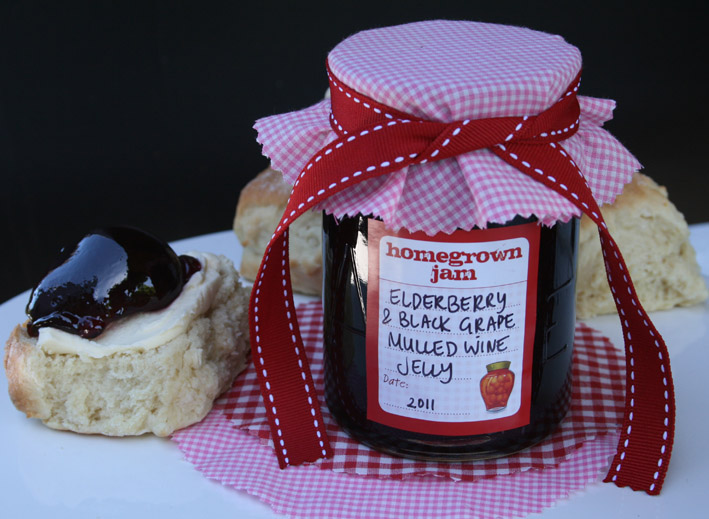
Figuring that the fancier a jam sounds, the more likely it is to appeal to the judges, I invented my own Elderberry, ‘Albany Surprise’ grape & Pinot Noir Mulled Wine Jelly. It’s my version of an uber posh preserve – and I have to say that it’s quite possibly the most delicious jelly I’ve ever made. Leaves quince jelly and crabapple jelly for dead, and not just because the colour is an intense ruby red.
The good thing about making jellies is that you really don’t need to stick to a recipe. Just bung any fruit you have – apples, crabapples, pears, feijoas, berries, guavas – into a pot, cover with water and simmer until the fruit is tender and pulpy. Then pour this pulp through a jelly bag or a double-folded piece of muslin (even a clean pillowcase will do the trick at a pinch) and let the juice drip out slowly into a bowl overnight. Resist the temptation to squeeze the pulp, as this can turn your jelly cloudy. The next day, measure the volume of liquid and bring it to boil in a pot. Then add an equal volume of sugar (ie, 2 cups of juice = 2 cups sugar). Stir constantly until the sugar dissolves, then boil rapidly until the liquid changes consistency and goes clear. (If you’ve never made jelly before, this is quite a noticeable change when it happens, and is usually accompanied by the sudden formation of scum on the surface, which is easily scooped off.) Test for setting point, then pour into jars and seal. And here’s my cheat’s tip: use Chelsea Jam Setting Sugar, which contains pectin and citric acid. It makes foolproof jelly in 5 minutes. Until I started using this special jam sugar, I could never get my red cherry guava jelly to set firmly (I just pretended I was making guava cordial or guava sauce).
To make my mulled wine jelly, I started with a few handfuls of dark purple elderberries off the scrubby old shrub in my city garden. I used them more for their colour than their flavour, which can be a tad overpowering. Elderberries are a roadside weed in most parts of the South Island, but if you want to grow a nice variety, Sarah Frater at The Edible Garden in Palmerston North has a beautiful lacy-leafed species called Sambucus laciniata. (It’s not listed in her mail order catalogue, but you can email her to request it. It has the same fruit as a standard elder but isn’t nearly as vigorous, which is a good thing! She also has the old-time variety ‘Adam’ in her Koanga Collection).
I placed the elderberries in a pot with 1kg ‘Albany Surprise’ grapes (the best variety for sweet, black, juicy grapes in late summer/early autumn) and lightly crushed them with a potato masher. Then I added 1 cup water, half a bottle of pinot noir wine, a cinnamon stick, half a dozen whole cloves and the zest of 1 orange (just peel it off in strips with a potato peeler, trying not to get any bitter pith). Add the orange juice too if you like. I also snuck in 2 star anise and a pinch of mixed spice (just because I had them in the pantry). Simmer over a low heat for an hour or so (don’t boil hard or the liquid evaporates and you’ll end up going through all this effort to make one miserable jar), then strain through a jelly bag overnight. Then measure the juice, add an equal quantity of sugar, and boil as per the instructions above.




 lynda hallinan